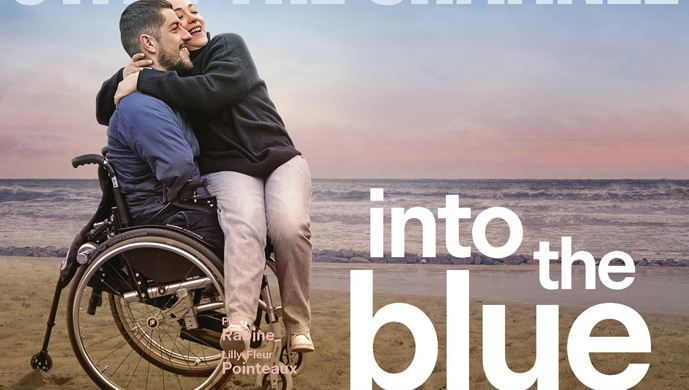

Into the Blue
/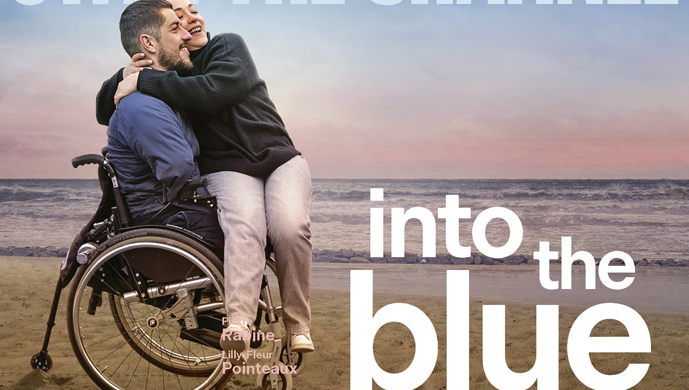
In this pre-theatrical release from Mountain Shadow, Suzana, a goat farmer who fled an abusive husband, learns to embrace life again through her growing relationship with Philippe; whose humor and sincerity heal her emotional wounds. Philippe, who’s left severely disabled after a tragic accident, also rediscovers joy alongside Suzana; the first person to truly see past his handicap. Together, with their five children, they form a blended family confronting daily challenges and cherishing life’s small pleasures. Driven by Suzana’s unwavering support, Philippe finds the strength to push his limits further than ever imagined, and undertakes an extraordinary challenge: to swim across the English Channel! NR – 1 hr. 57 min. – in French, with English subtitles.
INTERVIEW WITH DIRECTOR MARIE-CASTILLE MENTION-SCHAAR
Q: How did the project come about?
A: I discovered Philippe Croizon through a report broadcast on France Télévisions. I was deeply moved by his story and very surprised that no director had taken it on. I contacted him. He was familiar with some of my films and agreed to meet me.
Q: Why did he convince you to make this film?
A: Because I admire those who embody hope, resilience, and strength. Philippe is one of those figures who deeply attract me. I like to tell stories that give the viewer the feeling that they too can, move mountains. When the story is true, the impact is even stronger.
Q: Your filmography is often filled with stories inspired by real event.
A: Yes, it’s almost become my signature. They are always stories rooted in reality, even if I add a touch of fiction. But this fiction must always remain respectful of the people who inspire me. I care deeply that the protagonists recognize themselves in the film and feel honored by it.
Q: Have you ever been confronted with disability in your personal life?
A: Yes, intimately. This film is, in fact, dedicated to my maternal grandparents. My grandfather was paraplegic. Despite this, he led an exceptional life: a member of the Resistance, a savior of Jewish children, the founder of an institute for disabled people, a teacher, a man of boundless energy. I learned to walk by following his wheelchair. And my grandmother, a professional violinist, put her career on hold for love of him. Their story has been with me ever since.
Q: When you met the Croizon couple, you quickly understood that Suzana had to play a central role.
A: Yes. I was struck by the fact that she remained very out of the public eye, even though she is an absolute pillar in Philippe’s life. Falling in love with an amputee and following him through his extraordinary challenges shows that love and companionship can transcend all difficulties. That’s why I loved their story so much.
Q: You insisted on casting the role of Philippe with an actor who is actually an amputee. Why this choice?
A: First and foremost, as a viewer. I knew that I would be much more moved, more involved, if the actor truly shared Philippe’s physical condition. And, quite simply, using special effects to “create” an amputated body represented a colossal cost—more than three million euros—and, in my view, an artistic and ethical aberration for this project.
Q: How did you cast Pierre, the lead actor?
A: I typed into a search engine: “man who is a quadruple amputee,” “swimmer.” And I came across his profile. I contacted him on Instagram, and he replied. I went to meet him and was struck by his presence, his energy, and his good looks. He too had been electrocuted on a high-voltage power line at his workplace. Like Philippe, he was a competitive swimmer. There were many similarities between them. I asked him to read the script. He accepted with remarkable courage.
Q: He wasn’t an actor to begin with?
A: No, but what was so moving was that he didn’t need to “act” certain emotions. He had experienced hardships similar to Philippe’s. This gave his performance authenticity.
INTERVIEW WITH THE COUPLE ABOUT WHOM THE STORY IS TOLD
Q: What’s it like seeing your story told on the big screen to the public?
Suzana: It’s crazy. We come from very modest backgrounds. I was a cleaning lady, a goat farm worker. So, seeing ourselves there, projected in a movie theater, is totally surreal. Philippe, on the other hand, is used to being in the public eye, at his conferences or in the media. For me, fame is going to be something new.
What advice did you give Pierre Rabine to help him get into character?
Philippe: Just one thing: “You are you. You are not Pierre playing Philippe. You are Philippe.” He didn’t need to overdo it. He had to stay simple, stay true to himself.
Q: Suzana, what was your impression of Lilly-Fleur Pointeaux, the actress who plays you?
A: Suzana: When I met her, I immediately knew she understood my character. And, when I saw her act, it was unsettling. She captured something very profound. She is sometimes stronger than me in certain scenes, but it rings true.
A: Philippe: The first time I saw Lilly-Fleur arrive, I said to Suzana, “It’s you, it’s incredible.”
Q: Suzana, you say that Marie-Castille granted two wishes on screen. Which ones?
Suzana: The first was that I was able to fall into Philippe’s arms when he arrived on the French shores. In reality, that’s not allowed because the escorts aren’t allowed to disembark, due to regulations and security. So I stayed on the boat. The second was being surrounded by my daughters at that moment, even though they weren’t present.